
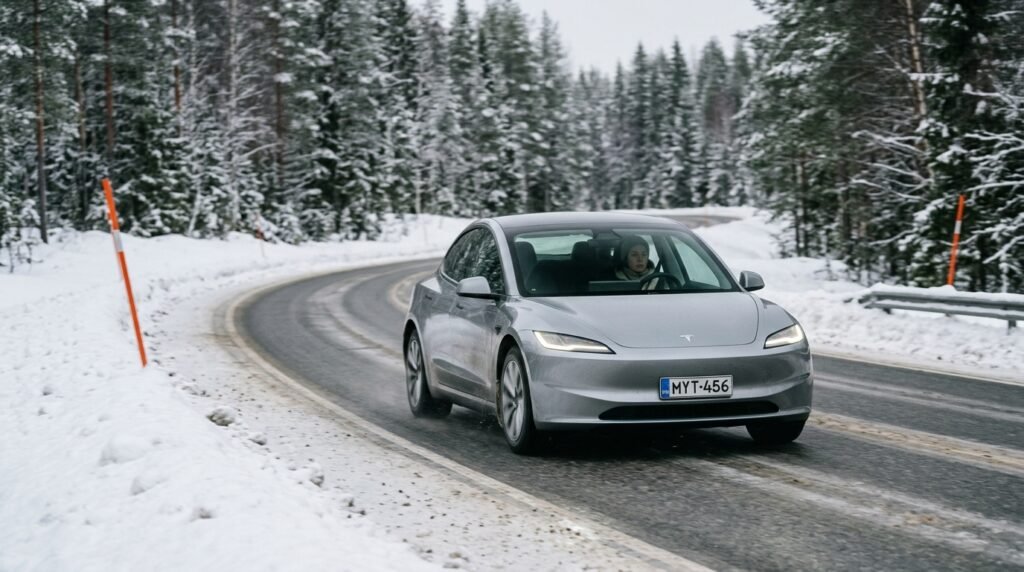
Driving through a Finnish winter can look like an absolute dream: empty highways winding through towering pine trees blanketed in fresh white snow. But then you hit a bridge coated in invisible black ice, or a heavy blizzard drops visibility to twenty meters, and you quickly realize why Finns take cold-weather driving with deadly seriousness.
Winter driving here is not terrifying once you understand the rhythm and respect the rules. Here is what Finnish traffic law requires, the truth about studded versus friction tires, and the small everyday habits that keep you out of a snowbank.
1. The Law: When Winter Tires Are Mandatory
Under Finnish road traffic law (Tieliikennelaki), winter tires must be used from November 1 to March 31 whenever weather or road conditions demand it.
Notice that phrasing: it is condition-based. If snow falls in mid-October up north, you must have winter tires on. If ice lingers into mid-April, you cannot switch back to summer tires yet.
- Minimum Legal Tread Depth: The statutory minimum for winter tires is 3.0 millimeters. However, ask any experienced Finnish driver or roadside mechanic and they will tell you: driving on 3 mm tires on wet slush is asking for trouble. Keep your tread at 4.0 to 5.0 mm for real grip.
2. Studded vs. Friction: The Eternal Finnish Debate
Every October, Finnish coffee rooms and car forums debate this exact question:
- Studded Tires (Nastarenkaat): These have small, hardened metal studs embedded directly in the rubber. When you hit sheet ice, freezing rain, or hard-packed lake snow, nothing beats studded tires. They dig into the ice like cleats. They make a noticeable clicking hum on bare asphalt, but for suburban roads, country highways, and driving up north, they provide unmatched security.
- Friction Tires (Kitkarenkaat): These are studless tires made with specialized soft Nordic rubber compounds and thousands of micro-sipes that grip snow. They are quiet, smooth, and can be driven year-round if needed. If 90% of your driving is inside well-salted city centers like Helsinki, Espoo, or Turku, friction tires are wonderfully comfortable. But on sheer black ice, studded tires stop in shorter distances every time.
3. The Parking Pole & Block Heater (Lohkolämmitin)
Walk through any Finnish apartment parking lot in January and you will see black electrical cables running from small metal posts directly into car front bumpers. No, they are not electric cars—they are traditional petrol or diesel engines plugged into engine block heaters (lohkolämmitin).
Starting a frozen engine at −20°C causes massive engine wear and drains your 12V battery. Plug your car into the pole for 1 to 2 hours before driving. It gently warms the engine coolant so the car starts easily. Even better, most setups include a small interior fan (sisätilanlämmitin) that blows warm air inside the cabin, completely melting the ice off your windows before you even turn the key.
4. Beware of Black Ice & The Moose Hazard (Hirvivaara)
Black ice (musta jää) is thin, transparent ice that freezes over dark asphalt. You cannot see it. You will find it most often on bridges, overpasses, and roads running alongside open lakes when temperatures hover right between −2°C and +2°C. If your steering wheel suddenly feels feather-light and silent, you are on ice: gently ease off the accelerator, keep your steering straight, and do not slam the brakes.
And then there is the moose warning sign (hirvivaara). With over 100,000 wild moose in Finland, these signs are not decorative. An adult bull moose can weigh 600 kg, and because their legs are long, a collision sends that massive body straight through your front windshield. Drive with headlights on at all times (mandatory by Finnish law 24 hours a day, all year round) and continuously scan the tree line at dawn and dusk.
• Sturdy long-handled snow brush and a brass-blade ice scraper
• −40°C rated winter washer fluid (summer fluid will freeze solid and crack your lines)
• Warm gloves, wool beanie, and blanket kept in the passenger cabin (not locked in the trunk)
• Reflective safety vest (keep inside the glove compartment so you wear it before stepping out on dark highways)
• Compact snow shovel and jumper cables
For more essential tips on dressing for the cold and staying warm on the move, check out our flagship Winter Survival Handbook.
Kommentit
Ei vielä kommentteja. Kommentoi ensimmäisenä.